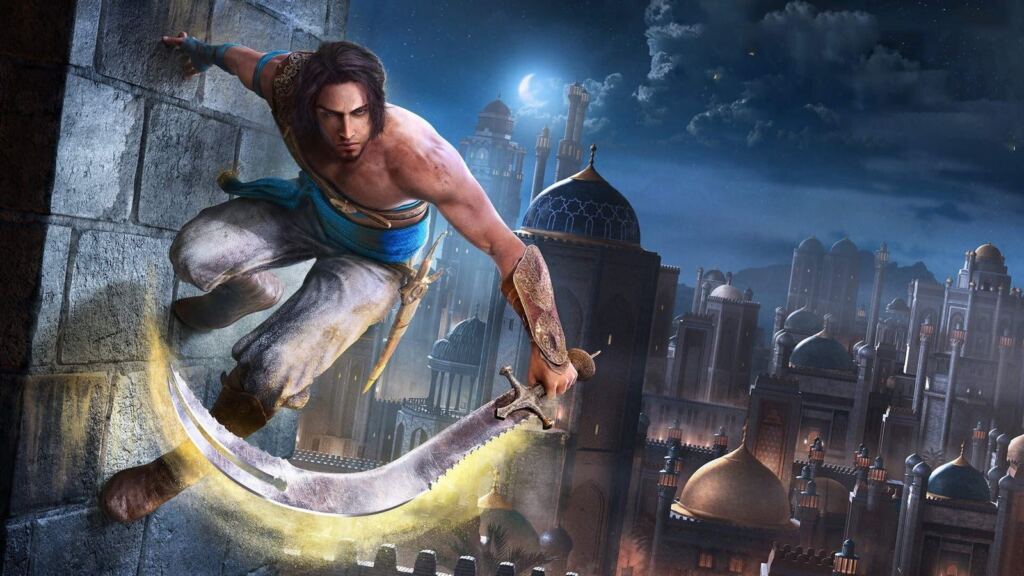
Anyone who rented the 2003 Prince of Persia from the local video store remembers the trick that changed everything: miss a jump, hold a button and the sands of time hand back the last few seconds. Twenty-three years later, Ubisoft’s classic shows both sides of the re-release story: a remake that dragged on for more than five years and ended up cancelled, and the original PC version, which GOG fixed so it runs properly on today’s machines.
A remake announced in 2020
The Prince of Persia: The Sands of Time remake was revealed at Ubisoft Forward in September 2020, developed by Ubisoft Pune and Ubisoft Mumbai in India and dated for January 21, 2021 on PC, PS4 and Xbox One. The first trailer went down badly with fans, who found the visuals too plain; Ubisoft replied that the style was a deliberate choice.
The date moved to March 18, 2021, and in February of that year the game was delayed indefinitely so Ubisoft could deliver a remake that “feels fresh while remaining faithful to the original”. In May 2022, Ubisoft Montreal, the same studio that made the 2003 game, took over. In November 2023 the series’ official account said the project had passed “an important internal milestone”, and at Ubisoft Forward in June 2024 came the new target: 2026.
The cancellation, in January 2026
That target never arrived. On January 21, 2026, Ubisoft announced an internal reorganisation that cancelled six games, four of them never announced, and gave seven others more development time. The remake was on the list. The team said goodbye on the series’ channels: “While the project had real potential, we weren’t able to reach the level of quality you deserve, and continuing would have required more time and investment than we could responsibly commit.”
The brand lives on: Ubisoft listed Prince of Persia among the series of one of its new creative divisions, the one dedicated to fantasy worlds and story-driven games, and the series had a recent release with Prince of Persia: The Lost Crown in 2024.
Meanwhile, the original runs again
On the other side of the counter, the 2003 game got a restoration. In August 2026, GOG explained how it brought The Sands of Time into its preservation programme. The problem was an old one: like so many games of the era, the original tied physics, collision and game speed to the frame rate, and the field of view to the 4:3 format. On modern PCs, running faster than intended, the Prince clipped through walls, fell out of the world and ladders stopped working.
The fix was a set of libraries that sit between the game and DirectX 9 and know exactly when each frame starts and ends. As a result, the GOG version runs at 60 frames per second without relying on vertical sync, supports current resolutions and recalculates the field of view for widescreen displays. According to the store, it was the first game to get this treatment, and the same base can serve other DirectX 9 games of that generation.
The video store lesson
Those who lived through that era know a good game ages better than many promises. The remake fell by the wayside; the original, with a 92 on Metacritic and more than 14 million copies sold, according to GOG, is playable on PC again without hacks. For series creator Jordan Mechner it all began with a simple wish, as he told Ubisoft in 2024: “Wouldn’t it be cool to not have to die and restart so often?”
Where to buy
Prince of Persia: The Lost Crown on Amazon
Affiliate links: SavePoint may earn a commission at no extra cost to you.
Source: Ubisoft and GOG.

 SavePoint Team

 Max Xavier