
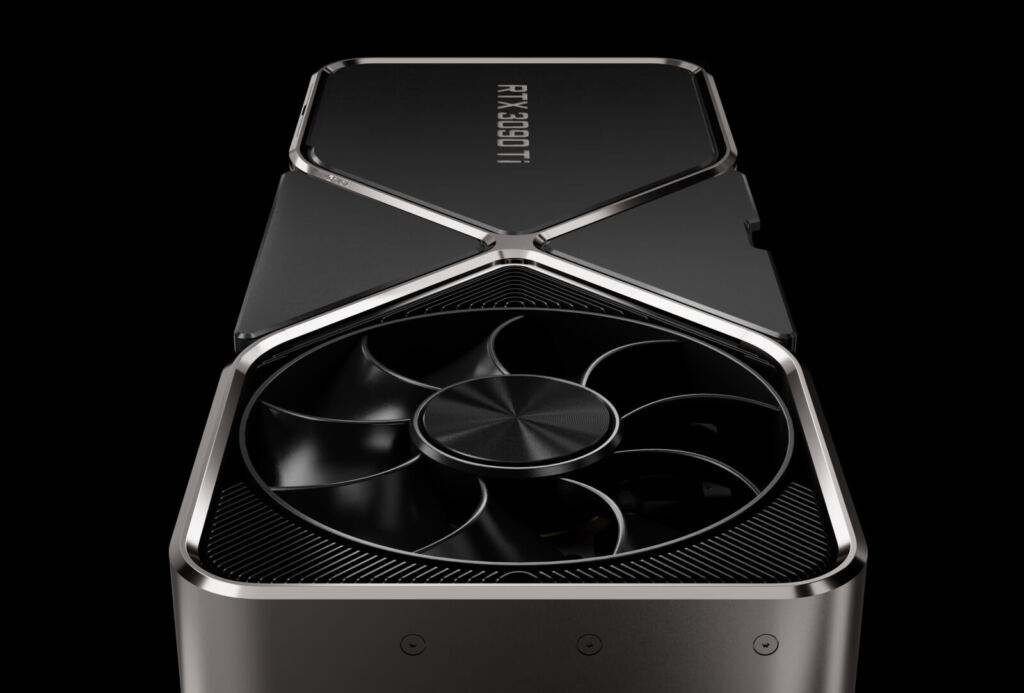
Brace yourselves, dear readers: it turns out GeForce RTX 3090s have been running with half of one of their engines switched off. A free, open-source project called gpu-unlock removes a cap that kept one specific kind of AI math at half speed on RTX 30-series cards. In Brazil, the story took off after Fabio Akita shared it on X, quoting a user who measured the jump in PyTorch: from 75 to 135 TFLOPS on an RTX 3090 capped at 360 W.
Before anyone rushes to “double” their card, one clarification: the whole GPU does not become almost twice as powerful. It is a very specific part of it, and the big winners are people running AI on Linux.
What exactly was capped
On Ampere GeForce cards, FP16 and BF16 Tensor Core operations with FP32 accumulation, the kind of math that dominates AI training and inference, run at half the rate of NVIDIA’s equivalent professional cards. That is in the official specs for consumer cards: it is product segmentation, not a defect. gpu-unlock, created by developer Zagitta, brings that rate up to the professional level.
How it works
It is a Linux kernel module that loads before NVIDIA’s driver, sets the registers that control that rate, resets the GPU and hands everything over to the stock, unmodified driver. There is no VBIOS flash, no patched driver and no hardware change: power the PC off and the card is back to normal. It has been reported working on the RTX 3090 Ti, 3090, 3080 (10 and 20 GB), 3070 and 3060 12 GB. An experimental Windows port has only booted on one machine.
The numbers: on paper and in practice
- RTX 3090 Ti: BF16 matrix multiplication rose from 87.5 to 157.4 TFLOPS, about 80% more, according to a report in the repository.
- RTX 3090: in another community test, BF16 went from 77.5 to 129.6 TFLOPS (+67%) and TF32 from 40.2 to 69.8 TFLOPS.
- By card: reported BF16 gains range from 25% to 80%. The smallest come from cards with low power limits, around 225 W.
- Real AI workloads: this is where the magic shrinks. With language models running locally, prompt processing improved between 1.5% and 36% depending on the test, and text generation barely changed. In ComfyUI image generation, one user measured 47% to 59% more. Outputs are bit-identical to the card without the unlock.
- Games: no test shows higher FPS. DLSS uses the Tensor Cores, so in theory it could benefit, but for now that is speculation.
The risks before you try it
Muahaha, but responsibly. The project is experimental, Linux-only and unofficial: NVIDIA has not commented, and anyone who installs it does so at their own risk. If something goes wrong, do not count on the manufacturer or the store to fix a problem caused by an unofficial tool. Practical points the project itself lists:
- Suspending the PC resets the setting (the module reapplies it on resume), and hibernation is not supported.
- The main card’s screen goes black during the reset until the display driver takes over.
- If the process gets stuck, you must fully power off the computer before trying again.
- More math per second means the card works closer to its power and temperature limits.
For anyone using an RTX 3090 for AI on Linux who knows what they are doing, it is free performance hiding in the silicon. For anyone who only games, nothing changes for now.
Where to buy
Source: gpu-unlock repository (Zagitta) and user reports on GitHub, Notebookcheck and Fabio Akita on X.

 Hélio


 SavePoint Team