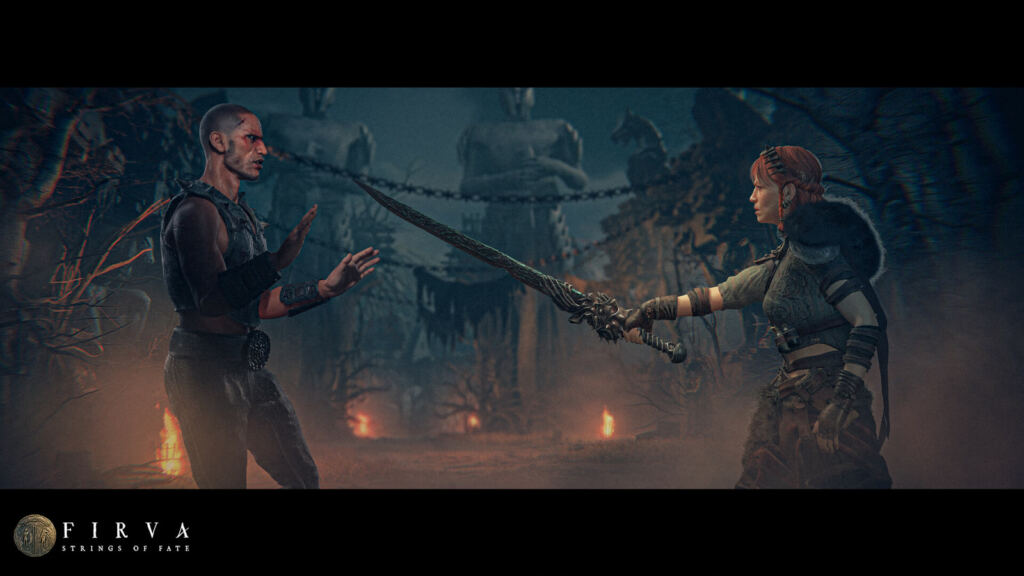
Firva: Strings of Fate (Part 1) is a cinematic dark fantasy action-adventure made by a team of just five people: Gord Games, an independent studio based in Turkey. Firva has spent her life hunting the man who killed her parents; when she finally gets her revenge, she finds one of the legendary Strings of Fate, an object that may bring the dead back, and the story stops being only about revenge. The demo has its own Steam page and is part of Steam Next Fest, which runs until October 26, and the game’s page lists Brazilian Portuguese. Part 1 has no release date yet.
I spoke by email with Armin Hashemzadeh, producer at Gord Games, about how five people make 40 minutes of cinematics, how to tell the story of a heroine without a tongue and why the studio pulled out of the festival twice before getting here. Disclosure: SavePoint received early access to an initial build of the demo from Gord Games.
The interview
Who is Gord Games, and how did the five of you come together?
“Gord Games is a small independent game development studio, and we’re currently a team of just five full-time developers working on Firva, based in Turkey. Personally, I’ve been involved in game production for close to a decade, while other members of our team have experience working on previously released games and building creative businesses. First it was two people, then slowly a friend called another friend; people joined and left, but the core team of five stayed the same.”
“We didn’t have a large team, a major publisher, or a multimillion-dollar budget. We had an idea, a small group of people who believed in it, and perhaps more ambition than was reasonable! For nearly two years, we’ve been trying to turn that ambition into something players can experience.”
How did Firva start, and why a story about revenge?
“Firva actually started with a question: could a small independent team bring back the feeling of classic, cinematic action-adventure games while creating something with its own identity? Revenge gives a character a very clear purpose. But what happens when revenge is no longer enough? We wanted to tell a story about someone who finally gets what she’s spent her entire life pursuing, only to discover that what she truly wants is something else entirely.”
Firva cannot speak. How do you tell her story?
“This is actually one of the most interesting creative challenges we’ve faced. We rely on her body language, reactions, interactions with other characters, and especially the relationship she has with the animals around her, particularly her wolf companion. Facial expressions are something we have not implemented yet. We’ve also put considerable effort into cinematic direction, framing, animation, music, and environmental storytelling. Firva’s silence isn’t simply a limitation; it’s part of who she is. Whether we’ve succeeded is something players will ultimately decide!”
How does a team of five produce around 40 minutes of cinematics?
“I think this is probably one of the hardest parts of developing Firva. We’re developing it in Unity, using HDRP, with Unity Timeline and Cinemachine for sequencing and camera direction, iClone in our animation workflow and Wwise for audio. We also used very old Vicon motion capture sensors in an old studio. But our biggest advantage is our production approach: reusable workflows for cameras, animation, character setups, and cinematic events rather than treating every scene as a completely separate production. Much of Firva’s environmental art has been created by just one artist.”
“And we should be clear: we’ve rebuilt systems, redesigned scenes, cut ideas, and delayed milestones more times than I would like to admit. Sometimes something that looks like a simple 30-second cinematic takes weeks of work. There is no secret technology that makes this easy.”
Which games inspired the combat with a fixed cinematic camera?
“Two of our most important early inspirations were the original God of War games and the classic Prince of Persia adventures, because of how they used cinematic cameras to direct the player’s attention and create memorable moments. Atmospherically, we’ve also drawn inspiration from Bramble: The Mountain King and Hellblade. At the same time, we wanted the responsiveness and timing of modern action games: precise dodges, aggressive combos and well-timed parries, which are still under development and which we were not able to implement correctly yet.”
Why does the demo have its own Steam page, and what feedback do you want?
“We wanted players to have a dedicated place to discover and evaluate the experience, and to distinguish the demo from the complete game, which is still very much in development. Are the controls comfortable? Does combat feel rewarding? Are the cinematic cameras helping or making certain moments more difficult? Does the story create enough curiosity? Constructive criticism is probably more valuable to us right now than compliments.”
What changed between the early build and the public demo?
“Our public demo contains more than 30 minutes of gameplay, and our biggest priorities have been stability, bug fixing, gameplay responsiveness, combat feedback, camera transitions, and general polish, with lots of localization. One thing worth mentioning is that we’ve postponed our Steam Next Fest participation two times. On one occasion, we withdrew just five days before the event because we didn’t feel the game was ready. The public demo is not the finish line.”
Why Brazilian Portuguese?
“Brazil is a market we genuinely want to reach, with a large and passionate gaming community. For a game where atmosphere, emotion, and storytelling are central, we don’t want language to become a barrier. Brazilian Portuguese is one of the languages we’re working to support; we’re still finalizing the language rollout and making sure the available builds accurately reflect that support. It would mean a great deal to our team to see Firva find an audience in Brazil.”
How many parts do you plan, and when does the first one arrive?
“We’ve always imagined Firva as a larger story, but we’ve learned that making ambitious promises is much easier than delivering on them. We don’t want to announce a fixed number of parts before we’re confident in our production roadmap (but 4 is a nice number). Part 1 will come when it meets the quality and stability standards we’ve set; we haven’t committed to a final public date yet. A realistic promise is always better than an exciting promise you can’t keep.”
What would you tell other small teams who want to make cinematic games?
“That it’s possible, but it’s probably going to be much, much, much harder than they imagine. Understand your limitations early and design around them rather than pretending they don’t exist. Build something playable as soon as possible, test your ideas before investing months in them, create workflows that let you reuse your work, and don’t be afraid to cut something. Also, don’t underestimate the emotional cost of development. We’re not trying to prove that five people can replace a hundred-person studio. We’re trying to prove that you don’t need a hundred people to tell a story worth experiencing.”
Answers lightly edited for length and clarity.
Where to buy
Source: SavePoint email interview with Armin Hashemzadeh (Gord Games).
 Max Xavier